
Etiquette is everywhere.
It’s a set of invisible rules that unconsciously, and sometimes consciously, govern our social interactions.
From networking etiquette, to social etiquette, meal time etiquette and professional etiquette. With so many unwritten rules informing our daily social interactions, it can be almost impossible to know what the right thing to do is in any given situation.
When it comes to the freneticism and sheer volume of online interactions, most of us have been lulled into the false belief that email etiquette is not an essential career skill. Our capacity to complete tasks efficiently and achieve a result is often considered more important than how that result was achieved. This means that most emails are assigned little time and consideration before being sent to their unwitting recipient.
But an email reveals more about you than you might think. Often it is the first impression you make on another person. Structure, tone and content are all important elements in conveying your core message. If rushed and poorly constructed, a bad email can quickly elicit a lasting negative response.
Some Hard And Fast Rules For Good Email Etiquette
- Try to keep your sentences and language brief and to the point
Always remember to ask the person you are emailing how they are. It starts your dialogue off on the right foot.

- Wherever possible, always try to reply to emails within 24 hours
- Never sign off an email with a smiley face, a kiss, a wink or an emoji
If you cannot express something adequately with words then leave it out completely.
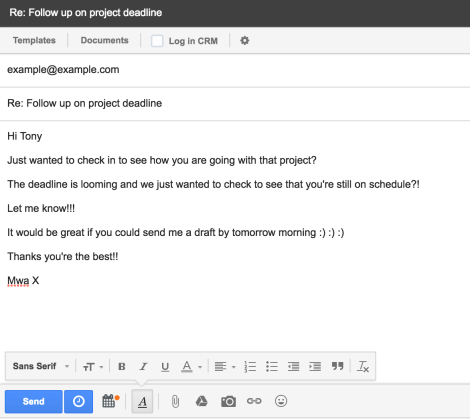
Don’t do this.
Using smiley faces and a seemingly harmless “X” at the end of a professional email can make you seem overly emotional, overfamiliar, lacking in emotional intelligence and weak. It can also come across as passive aggressive or that you are too lazy to say what you really mean.
- Avoid unnecessary punctuation such as CAPITALISATION, bolding and exclamation points!!!
Nobody enjoys feeling as though they are being yelled at over an email exchange. There are better ways to reinforce an urgent deadline.
- Never ignore an email from somebody more senior than you. This rule also applies to volunteer positions
If someone in a senior position has asked you to take on more work, to find information on a project, to chase down a lead or even what your stance is on a certain issue, always respond as quickly as possible. Even if your response is just a brief acknowledgement email along the lines of:
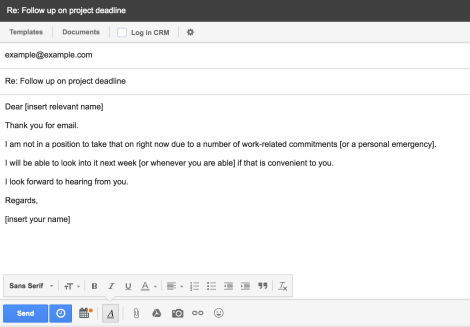
Try to respond like this.
Not responding at all sends a clear and unambiguous message that you do not care about your senior manager’s needs. It also tells the story that you do not value your role, that you have poor time-management skills and that you are not coping.
Remember, the person who supervises your work determines your salary increment and eligibility for promotion. They are also in a position to give you a glowing (or terrible) referee report one day.
Their opinion matters, so always try to go above and beyond in your interactions.
- Keep your commitments: If you commit to completing a task then stick with it
If you find that your circumstances change and you are no longer able to take on a task you committed to, have the confidence and courtesy to tell the person to whom you made that commitment. Being up front means that everyone knows where they stand.
Communicating your needs early also helps your manager do their job more effectively by being aware of which tasks need to be reassigned.
- Keep emotion out of it: Email communication should be professional and avoid unnecessary emotion
Sometimes the best professional communication technique involves knowing when to speak up and when to zip it.
Signing Off
Social regulations, particularly in a work context, are some of the most difficult to master. Everything depends on your office environment, company culture, past practices as well as who is supervising you.
If you work in an environment where the exchange of casual emails is commonplace, you may find yourself charmed by their informality, and tempted to respond in kind.
When this happens, and you are on the verge of stripping away a layer of professionalism from your digital correspondence, always remember before hitting SEND that you can never get yourself into trouble by being too professional.
Dressing for success is important, but developing a professional and authentic communication style is just as critical in shoring up a rock solid career trajectory.
What techniques do you use in email writing? Let us know in the comments!
